

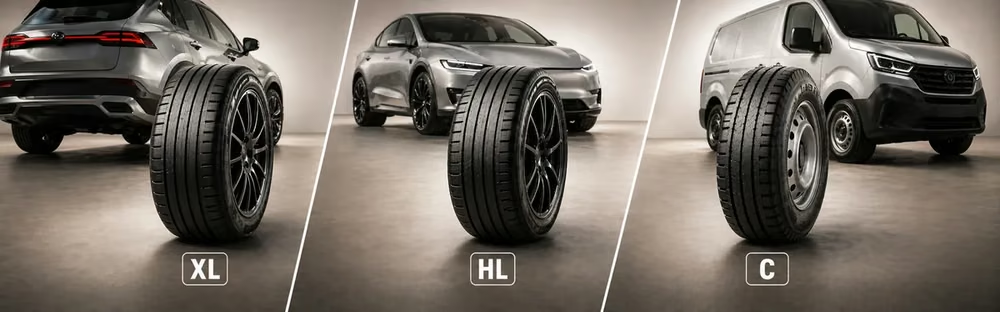
Where these letters sit on the sidewall
Tire load markings tell you how much weight a tire can safely carry. Three special letters are used in Europe: XL (reinforced for heavier passenger cars), HL (a 2021 standard for heavy EVs) and C (commercial — vans and light trucks). Each appears in a different spot in the size code:
- XL — at the end, after the speed rating: 205/55 R16 91 V XL. May also be written as RF, REINFORCED or EXTRA LOAD — all four mean the same thing.
- HL — at the very beginning, in front of the size: HL 245/40 R19 101 Y.
- C — glued to the rim diameter, no space: 215/65 R16C 109/107 R.
XL — Extra Load (reinforced)
XL stands for Extra Load. The tire is built with reinforced sidewalls, a stronger bead and extra plies under the tread, so it can carry roughly 10–20% more weight than a standard (SL) tire of the same size. To reach that capacity it needs a higher inflation pressure — typically up to 2.9 bar (42 psi) versus 2.5 bar (36 psi) for SL.
You should fit XL tires whenever the vehicle manufacturer specifies an XL load index — heavy SUVs, premium sedans, vans loaded with passengers, and most cars towing a trailer. Going lower than required risks sidewall failure under load.
On the sidewall the marking can read "XL", "RF", "Reinforced" or "Extra Load". The load index number itself is also higher: an XL 94 carries 670 kg vs. 615 kg for a standard 91 of the same physical size.
HL — High Load (the new EV standard)
HL — High Load — was introduced by ETRTO in January 2021 (and adopted in the US in 2023) specifically for heavy electric and hybrid vehicles. A typical EV is 300–500 kg heavier than a comparable petrol model because of the battery, but designers can't always go to a bigger wheel size for aesthetic and aerodynamic reasons. HL gives the tire ~10% more capacity than XL — roughly +23% over a standard SL tire — while running at the same 2.9 bar (42 psi) pressure as XL.
The marking position is different from XL: HL is a prefix written in front of the size, e.g. HL 245/40 R19 101 Y. If you see HL, the size cannot be replaced with a regular XL of the same dimensions — the load index will not be enough even if the numbers match.
HL tires are typically required on heavy Tesla, Audi e-tron, Mercedes EQS, Volvo EX90, Volkswagen ID. Buzz and similar EVs. Continental and Pirelli were the first manufacturers to release them in production.
C — Commercial (vans and light trucks)
A C at the end of the rim diameter (R14C, R15C, R16C) marks a euro-metric commercial tire. This is not the American „Load Range C" — it is a separate ETRTO category for vans, light trucks and trailers carrying heavy cargo. Construction uses additional plies, stronger beads and stiffer sidewalls, and the maximum pressure is typically up to 3.5 bar (50 psi) or more.
Commercial tires use a dual load index, e.g. 109/107 R. The first number is for a single-wheel axle; the second — for a twin-wheel (dual-rear) axle. The speed rating is usually lower (Q, R, T, sometimes H), because the tire is built for load, not high-speed cruising.
Typical applications: Mercedes-Benz Sprinter, Ford Transit, Volkswagen Crafter, Renault Master, Fiat Ducato, Citroën Jumper, Opel Vivaro, Iveco Daily and similar 3.5-tonne vans. Fitting a passenger XL tire instead of a C-tire on a loaded van is dangerous — the sidewall is not built for that mass, especially at highway speed.
→ See commercial (C) tires in the catalog
Quick comparison table
| Marking | Load vs. SL | Max pressure | Position in size | Typical use |
|---|---|---|---|---|
| XL | +10–20% | 2.9 bar / 42 psi | Suffix (end) | Heavy passenger cars, SUVs, towing |
| HL | +~23% | 2.9 bar / 42 psi | Prefix (front) | Heavy EVs and PHEVs |
| C | Truck class | 3.5 bar / 50+ psi | After rim (R16C) | Vans, light trucks, trailers |
Concrete example — how much load capacity changes
Look at how dramatically the load capacity changes for a tire of the same physical size when only the marking differs:
- Standard 91 (SL) — 615 kg at 2.5 bar (36 psi).
- XL 94 — 670 kg at 2.9 bar (42 psi) — about +9% more.
- HL 101 — 825 kg at 2.9 bar (42 psi) — about +34% more than the SL 91.
⚠️ Never go below the required load index
Going lower is dangerous. If your registration certificate or door placard requires a 94 XL tire, fitting a 91 SL is unsafe — the sidewall cannot carry that mass and you risk a blowout. Going higher is allowed (e.g. 96 XL on a vehicle that requires 94 XL); ride may be slightly stiffer and rolling resistance marginally higher, but it never reduces safety. Importantly, a higher-rated tire does not increase the vehicle's legal payload — that is set by the axle ratings, not by the tire.
How to read the markings on the sidewall
The full size string tells you everything in one line:
- 205/55 R16 91 V XL → 205 mm wide, 55% aspect ratio, 16″ rim, load index 91, speed V (240 km/h), Extra Load.
- HL 245/40 R19 101 Y → 245 mm wide, 40% aspect ratio, 19″ rim, load index 101, speed Y (300 km/h), High Load.
- 215/65 R16C 109/107 R → 215 mm wide, 65% aspect ratio, 16″ commercial rim, load index 109 (single) / 107 (dual), speed R (170 km/h).
Looking for tires with the right load rating?
Browse the catalog


