

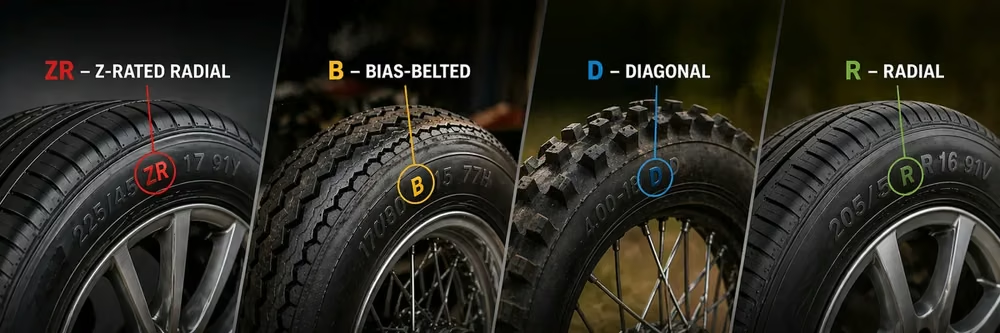
Where the letter sits in the size
Tire size format: width / aspect letter rim diameter. E.g. 205/55R16 91V — 205 mm wide, sidewall 55% of width, radial construction, 16-inch rim, load index 91, speed rating V.
Construction types
R — Radial
If you buy a new passenger-car tire today, it is almost guaranteed to be radial. R has been the factory standard since the 1970s, and roughly 99% of tires on the market are radial. In this construction the body plies run perpendicular to the travel direction, and under the tread a steel or kevlar belt wraps around the entire tire. The combination gives lower rolling resistance, better road contact, less heat build-up and a much longer tread life than the older constructions.
B — Bias-belted
Bias-belted is a hybrid. The body plies still run diagonally — just like on a pure diagonal (D) — but a stabilizing steel or fabric belt is added under the tread. The belt adds very little to the cost yet noticeably reduces tread deformation while driving, which is why the tire feels more stable and lasts longer than plain D. It appeared in the late 1960s as a compromise between cheap D and then-expensive R, and today it mostly survives on motorcycle and trailer tires.
D — Diagonal (pure bias)
Pure diagonal body plies with no belt under the tread. The sidewalls are thick and stiff, which is great for heavy loads — but the tread itself squirms while driving, builds heat, wears faster and grips worse. Until the 1970s this was the standard construction on every car; today it survives only in specific niches — vintage cars, agricultural equipment and some budget motorcycle tires.
ZR — Z-rated radial
At first glance ZR looks like a separate construction, but it is actually a historic speed rating for a radial tire capable of more than 240 km/h. Originally „ZR” simply meant „faster than V class”. Today it is almost always paired with a specific speed index: V (240 km/h), W (270 km/h) or Y (300 km/h). For example, P275/40 ZR17 93W means a tire 275 mm wide, 40% aspect, Z-rated radial for a 17-inch rim, load index 93 and a maximum speed of 270 km/h.
Cross-ply — no letter
Under the ISO standard, classic cross-ply tires carry no letter in the size — for example, „80/90-21” instead of „80/90R21”. That notation means old bias-ply construction without a belt, and you mostly see it on vintage cars and historic motorcycle tires.
Summary
| Letter | Typical use | Example |
|---|---|---|
| R | Passenger cars, SUVs, vans (~99%) | 205/55R16 |
| B | Motorcycles, trailers, some classics | 170/80B15 |
| D | Vintage cars, agricultural, budget motorcycle | 7.50-16D20 |
| ZR | High-speed sports cars | 225/45ZR17 91Y |
| — | Vintage and historic motorcycle tires (ISO, no letter) | 80/90-21 |
D and B — where is the line?
Both are diagonal (bias) constructions, which is why they are often confused. The real difference is a single thing — whether there is a belt under the tread.
| Feature | D (Diagonal) | B (Bias-belted) |
|---|---|---|
| Body plies | Diagonal (30–38° angle) | Diagonal (30–38° angle) |
| Belt under the tread | ❌ None | ✅ Steel or fabric |
| Tread stability | Low — deforms | Medium — belt holds it |
| Ride comfort | Low | Medium |
| Usually on | Vintage cars, agricultural | Motorcycles, trailers |
In short: B is the same D, just with a belt. In the 1970s the belt was a transitional step between D and R — while radials were still new and expensive, bias-belted offered half of their benefits at half of the cost. Today B survives where D’s strength is still valuable but tread stability also matters — mostly motorcycles and trailers.
Why radial became the standard
Compared with bias-ply, radial construction wins on a few fundamentals:
- Less heat build-up — the body plies don’t rub against each other as the tire flexes, so there is less friction and heat. That matters especially at high speed and over long distances.
- Better fuel economy — lower rolling resistance cuts fuel consumption by roughly 3–5%. Over the life of a tire that is several full tanks of savings.
- Longer tread life — steel belts keep the tread stable. A typical radial will cover around 100,000 km, while bias-ply averages only 30,000–50,000 km.
- Better grip — more flexible sidewalls let the tread follow the road, especially through corners and on wet surfaces.
Why motorcycle tires are often B or D
Odd as it sounds, bias-ply (B and D) is still a normal choice in the motorcycle world, not an antique. The reasons are practical:
- Stiffer sidewalls — they don’t flex too much under heavy loads or at steep lean angles in corners, which matters more on two wheels than on four.
- Compatible with spoked wheels — common on off-road and classic motorcycles, where modern radials simply don’t fit.
- Lower price and easier to repair — important for cruiser and off-road riders who change tires more often.
Modern sportbikes usually run on radial tires — they hold the road better at high speed. In the cruiser, off-road and classic world, bias-ply still has a rightful place. Before switching the construction type, double-check your motorcycle manual — the manufacturer has to approve it.
⚠️ Don’t mix different constructions
On the same vehicle you must not fit tires of different constructions — for example R on the front and D on the rear. It breaks safety regulations and clearly hurts handling, because the front and rear sidewalls react differently to the same inputs. Always follow the manufacturer’s recommendation — the registration document specifies the required construction.
How to read it on the sidewall
Every tire shows the full size on its sidewall, for example „205/55 R 16 91V” or „80/90-21 M/C 45P”. The letter between the aspect ratio and the rim diameter is the construction marker. If there is no letter, it is a cross-ply tire.
Frequently asked questions
Can I use a ZR tire instead of an R?
Yes. Fitting a higher-rated tire (ZR, W, Y) in place of a lower one (V, H, T) is perfectly safe — it handles lower speeds just as well. The other way around is not safe: a lower-rated tire in place of the required higher one can overheat and even blow out.
Can I mix R on the front and B on the rear?
No. Different constructions on the same car (R and B, or R and D) mean different sidewall stiffness, different deformation at speed and different grip — all of which severely hurt handling. In most EU countries it is outright illegal.
Are ZR tires better than R?
Not really. ZR is not a „better construction” — it is the same radial (R), just adapted for higher speeds. It has slightly stiffer sidewalls and a rubber compound that holds its shape at higher temperatures. At everyday speeds up to 100 km/h you will barely notice the difference.
How do I know which construction fits my vehicle?
Check the registration document — it lists the tire size and speed rating, for example „205/55 R 16 91V”. The letter R means a radial construction is required. The owner’s manual often lists alternative sizes as well. Never change the construction type on your own — only if the vehicle manufacturer explicitly allows it.
Looking for the right tires?
Browse the catalog


